People ask what a new furnace costs for a 2,000 sq ft house, or what the average is in Ontario. The honest answer is that floor area and provincial averages tell you very little. Two houses of the same size on the same Norwood street can need very different jobs. The equipment is only part of the price. The rest is what the house needs to take that equipment safely and properly.
This guide walks through what actually moves the number, so you can read a quote and know what you are paying for.
Most Norwood houses are older than their furnace
In the 2016 Census, 235 of the 560 occupied homes in the Norwood population centre were built in 1960 or before. Another 165 were built between 1961 and 1980. So most houses in the village are more than forty years old.
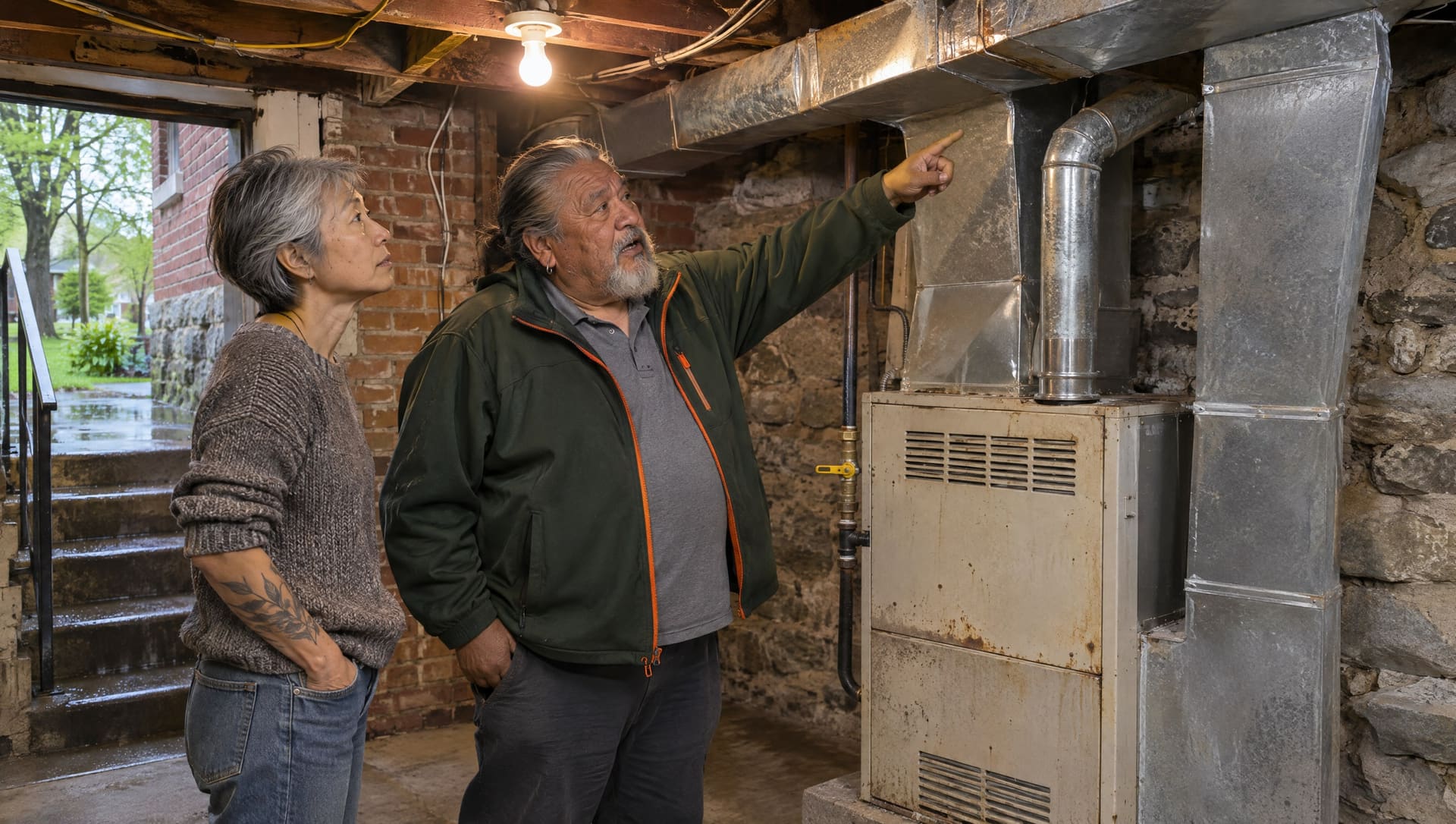
The oldest ones sit on the lots that grew out of Keeler's Mill on the Ouse River. Houses of that age were first heated with wood or coal, then converted to oil or gas. A technician opening the basement in one of these homes often finds:
- A replacement furnace far bigger than the house needs, sized to match the one before it
- Ductwork added after the house was built, often undersized or poorly sealed
- A brick chimney built for a large fire, too big for a modern appliance unless it has a liner
- Old wrap on ducts or pipes that may contain asbestos
Each of these can add work to a replacement. None of them shows up in a square-footage figure.
Square footage is a weak guide to size
A furnace should be sized to the heat the house loses on a cold night. That depends on insulation, windows, air leaks, ceiling height and which way the house faces, not just floor area. A well-insulated 2,000 sq ft house can need a smaller furnace than a draughty 1,400 sq ft one.
The common mistake is to copy the label on the old unit. In converted houses that label is often too big already. An oversized furnace heats in short bursts, cycles on and off, wears faster and leaves cold rooms at the ends of the duct runs. Sizing it properly sometimes means a smaller, less expensive unit. It always means someone measuring the house rather than reading the old nameplate.
What to ask: how was the size worked out? A quote that just repeats the old furnace's output has skipped this step.
Venting and the chimney change the job
A high-efficiency furnace does not use the chimney. It vents through plastic pipe out the side wall. That opens two questions that affect price.
First, where the pipes go. They need a run to an outside wall with the clearances the installation code asks for, away from windows, doors and the spot where drifts pile up in January. In some houses that run is short. In others it crosses a finished basement.
Second, what is left in the chimney. If a gas water heater still vents into a big old chimney on its own, it may not draft properly. The usual fix is a liner sized for the water heater. A good quote says whether a liner is needed, not just whether one is possible.
If the house is moving off oil, there is also the old tank and its piping to deal with, and a gas line to run if one is not already in place.
Ductwork is often the hidden cost
A new furnace pushes air through whatever ducts are already there. In older Norwood houses those ducts were often added later and are small, leaky or missing returns in some rooms. A modern variable-speed blower forced through undersized returns gets loud and works harder than it should.
Sometimes the right answer is to add a return or seal the main trunk. Sometimes the ducts are fine. The cost difference between those two is real, so ask what the technician found in the ducts and what they suggest doing about it.
If you see old white or grey wrap on duct joints or pipes, mention it before the visit. It may need testing before anyone disturbs it, and that is part of the job and the timeline.
What makes a high-efficiency furnace cost more or less
The question about the average price of a high-efficiency furnace has the same problem as the others: the range is wide and the reasons matter. The main ones:
- Burner type. A single-stage furnace runs at full output or not at all. Two-stage and modulating furnaces run lower most of the time, which is quieter and more even, and they cost more.
- Blower motor. Variable-speed blowers move air more gently and use less power, but they show up weak ducts faster.
- Condensate handling. High-efficiency furnaces make water. It has to drain somewhere, and in some basements that means a small pump.
- Install work. Venting, gas piping, electrical, a new return drop, the old unit's removal and disposal.
- Permits and code. Gas appliances in Ontario are installed to the CSA B149.1 Natural Gas and Propane Installation Code, adopted under Ontario Regulation 212/01. Work is performed by TSSA-certified gas technicians. Doing it to code is not optional, and it is part of the price.
Rebates and grants can lower the final number, but the programs change. See grants and rebates for a new furnace or heat pump in Ontario for how to check what applies before you sign.
Central air depends on whether the ducts can carry it
For central air in a 2,000 sq ft house, the first question is not the size of the house but the ducts. Cooling needs more airflow than heating. Ducts that were added to a converted house for a furnace are often too small to cool the upper floor.
What drives the price of central air:
- Whether there is already a furnace with a blower and coil space that suits the new system
- Whether the ducts and returns can move enough air, especially upstairs
- How far the outdoor unit sits from the furnace, and the line run between them
- Electrical capacity, since an older panel may need a new circuit or an upgrade
- Pad, clearances and drainage at the outdoor unit
Where the ducts cannot carry it, a ductless system can make more sense than rebuilding the duct system. The equipment is different, and so is the cost, so compare both before deciding. Refrigeration and air conditioning work in Ontario is a compulsory trade. Work is performed by 313A refrigeration and air conditioning mechanics.
See air conditioning installation for how the two approaches compare in an older house.
Newer homes are a different kind of quote
Houses in Norwood Park Phase 4 and similar new builds are tightly sealed, with high-efficiency furnaces or heat pumps, ventilation units and short duct runs. They rarely need chimney liners or duct rebuilds. When they have problems, it is usually a system that was sized wrong or never balanced at install. A replacement or added air conditioning there is usually simpler, but the sizing still has to match the house, not the builder's default.
If you are thinking about a heat pump, either alone or paired with a gas furnace, see heat pumps.
How to compare quotes
When two prices are far apart, the cheaper one has usually left something out. Lay them side by side and check:
- Was the house measured for heat loss, or was the old unit copied?
- Does it say where the new vents will go and how far from windows and grade?
- Does it say whether the chimney needs a liner for the water heater?
- Does it mention the ducts and returns, and any changes?
- Are gas, electrical, condensate drain, permits and removal of the old unit included?
- For central air, does it address upstairs airflow and the electrical panel?
A quote that answers all of these is one you can hold the installer to.
For a written price on your own house, see furnace installation and replacement.